
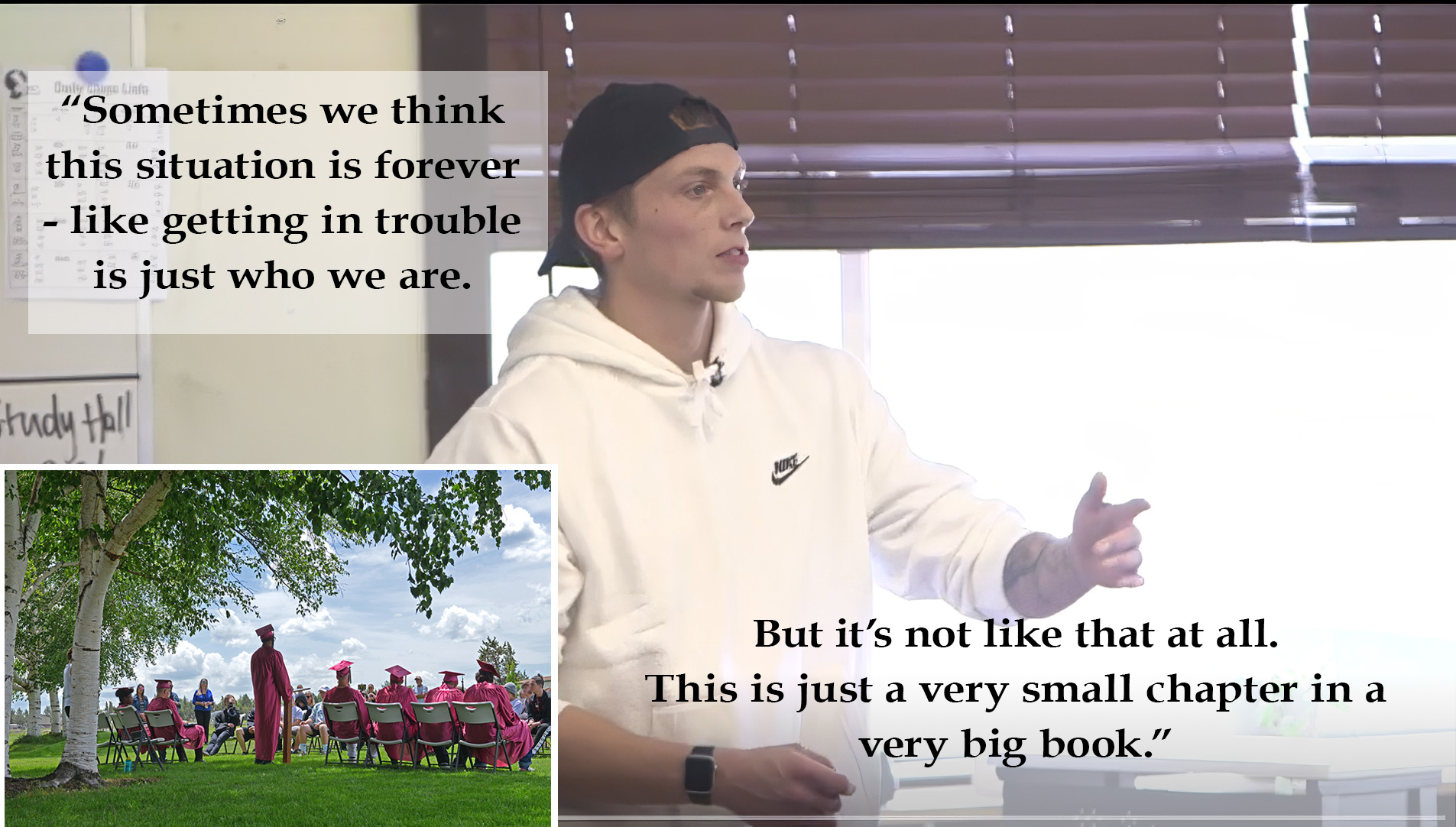
When Austin Cole walked back onto the campus of J Bar J Boys Ranch this winter, it wasn’t as a resident. It was as someone who had once sat in the same chairs as the young men in front of him.
“I know a lot of you guys are like, who is this kid standing up here?” he told them with a grin. “To be honest, I’m just like the rest of you. I sat exactly where you’re sitting for 18 months.”
At 23, Austin returned to J Bar J and J5 not because he was asked, but because he wanted to be there.
“I really wanted to come back and be the voice that I wish I had when I was their age,” he explained later. “If I only inspired change in one person, then everything I did today was worth it.”
Austin’s story is one that many of the young men in the room could recognize.
Growing up, he says he wasn’t a bad kid. He played sports and tried to keep up in school, but behavioral struggles followed him from one classroom to the next. By fourth grade he had already been expelled once. By high school, the cycle of suspensions, bad decisions, and legal trouble had begun.
“I started hanging around kids I thought were cooler than me,” he told the group. “I got around the wrong crowd and started doing really dumb stuff that got me into a lot of trouble.”
The consequences escalated quickly. Austin spent time in juvenile detention 13 times and cycled through multiple programs across Oregon, including J5 and J Bar J Boys Ranch. At one point he had earned zero high school credits.
But while he was in programs, something shifted.
“With the structure here, I started gaining ground,” he said. “I ended up getting 16 credits my junior year and graduating on time – something nobody thought I could do.”
Standing in front of the young men at the Ranch, Austin spoke openly about the choices that once defined his life and the realization that changed everything.
“Sometimes we think this situation is forever – like getting in trouble is just who we are,” he told them. “But it’s not like that at all. This is just a very small chapter in a very big book.”
He reminded them that programs like J Bar J exist for a reason.
“These people – the staff – they’re here to slow us down just enough so we can get out of our own way,” he said.
After sharing parts of his story, Austin turned the conversation over to the youth, inviting them to ask questions and talk about the challenges they expect to face when they leave the program.
One young man worried about reconnecting with old friends. Another spoke honestly about struggles with drugs. Others talked about family pressures, jobs, and the fear of falling back into the same patterns that led them here.
Austin met each question with honesty and empathy.
“How bad do you want the change?” he asked one youth. “Because that old life will always be there. But change will always be there too.”
Today, Austin says his life looks very different from the one he once imagined.
“I went from being homeless, living on the street, watching people inject meth while I was smoking it,” he said. “Now I’ve got a beautiful wife, my own place, and a good job.”
But for Austin, success isn’t defined by any of those things.
“My version of success,” he told the group, “is being able to come back to a place I swore I’d never come back to – and talk to you guys.”
Before leaving, he offered one final reminder.
“It’s never too late to grow,” he said. “Not for you. Not for anybody.”
For the young men at J Bar J Boys Ranch that day, the message came from someone who truly understood the road they’re walking – because he had once walked it himself.